Signal Messenger Enhances Protection Against AI Agents on Mobile Devices
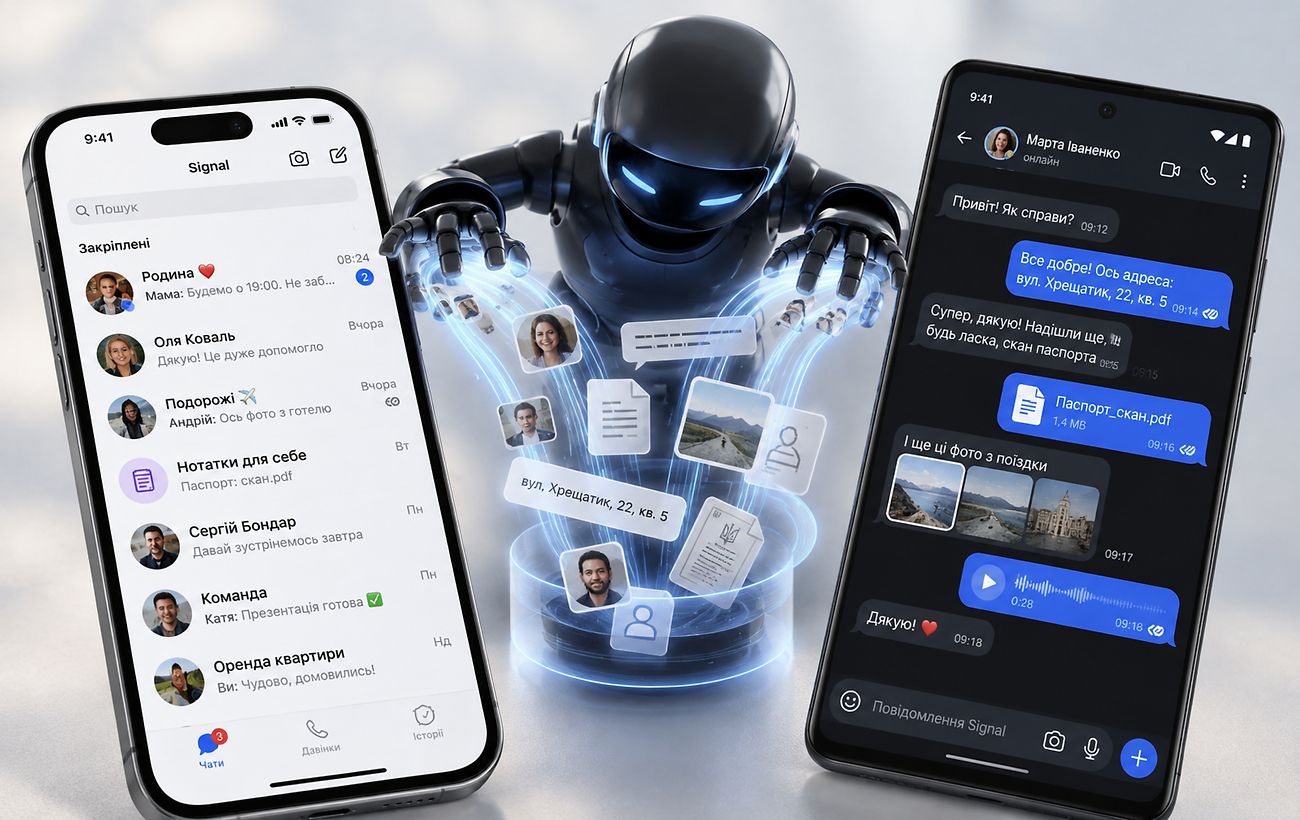
The secure messenger Signal is implementing screenshot restrictions on iOS and Android to protect user chats from interference by built-in artificial intelligence agents.
 💡Tech
Photo: RBC-Ukraine
Key points
- Signal blocks screenshots on Android and iOS
- Built-in AI poses risks of stealing chat data
- Developers urge tech giants to set privacy standards
The popular secure messenger Signal has announced additional security measures designed to protect user data from artificial intelligence algorithms embedded directly into modern operating systems. The new restrictions target mobile platforms Android and iOS, where systems like Gemini or Siri AI attempt to analyze screen content to perform tasks for users.
Threats from Smart Assistants in Smartphones
Messenger developers note that tech giants are actively integrating AI agent capabilities straight into mobile OS environments. These tools can continuously scan display contents, potentially leaking private conversations to local databases or remote corporate servers. The company recalls a similar precedent with the Recall feature in Windows 11, which also required default screenshot blocking.
To mitigate these risks, the Android application now blocks attempts by AI assistants to read the screen, while iOS introduces screenshot restrictions. Users can disable this protection in the app settings, though the company warns this will expose chat contents to AI agents and compromise privacy guarantees for both the user and their contacts.
Compatibility Issues and Developer Stance
The Signal team acknowledges that these measures do not completely solve the problem, as OS manufacturers currently fail to provide developers with granular tools to restrict AI access without hindering application functionality. Consequently, similar protection cannot yet be deployed on macOS. Developers are urging Apple, Google, and Microsoft to provide clear technical specifications and establish unified industry-wide privacy standards.
This situation illustrates the growing digital risks for residents who actively use modern smartphones and communication apps. Given that artificial intelligence tools are becoming deeply integrated into mobile operating systems, maintaining the privacy of personal correspondence is becoming crucial for every user. Such technical limitations from independent app developers signal that digital security requires closer attention to the privacy settings of personal gadgets. In practice, this means users must more carefully control access permissions granted to integrated assistants to prevent sensitive data leaks.
Source RBC-Ukraine — rbc.ua/ukr/news/shi-agenti-mozhut-chitati-vashi-chati-signal-179542… ↗
Read next
 🛡️Security
Geneva Talks Collapse: World Fails to Reach Binding Rules on 'Killer Robots'
UN-backed talks in Geneva on a legally binding treaty regarding autonomous weapons have failed due to Russian objections and resistance from other nations.
 ⚽Sport
Destruction of Russian Corvette 'Mercury' and its Significance for Russia's Geopolitical Ambitions
The recent destruction of the Russian corvette 'Mercury' off the coast of Libya has sparked discussions about its impact on Russia's strategic interests in the Mediterran…
 🩺Health
Winter weather and sharp cooling: forecasters predict snowfalls and icy roads
A wave of cold air with snow and wet snow is covering Ukraine. Meteorologists warn of difficult weather conditions and icy patches on roads.
 🎓Education
Forecasters warn of sharp weather changes and first frosts in Ukraine
Ukraine is facing a sharp cold snap and snowfalls this week. Meteorologists predict temperatures dropping below zero across most regions.
 🎓Education
Wheels Prevail: Why Ukrainian Military Increasingly Choose Wheeled Ground Drones
Market analysis of unmanned ground vehicles (UGVs) highlights the growing preference for wheeled platforms due to simplicity and efficiency.
 🎓Education
Poland Prepares Bill to Restrict Social Media Access for Children Under 15
The Polish Ministries of Education and Digitalization have drafted legislation to set a minimum age limit of 15 for social media usage.